
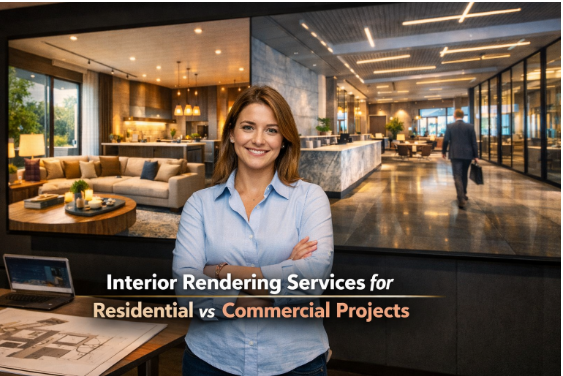

Interior design no longer needs an explanation via drawings. Today, clients require understanding, reality, and confidence before the actual construction begins. With the rise of more complex projects and shorter project times, the importance of interior rendering services has stepped up from a “nice-to-have” to a need.
This guide introduces the topic of interior rendering services, how they can be used, and what architects and designers can expect when utilizing these services in real projects.
What are Interior Rendering Services?
Interior rendering services use architectural designs and concepts and convert them into three-dimensional images. These images are 3D representations of interiors that demonstrate just what a space looks like when completed. The image captures all aspects of a space in a single image.
While technical drawings are primarily used as a means of communication, the objective of renderings is communication itself. Renderings assist clients in understanding the design without having to interpret the drawings.
Why Interior Rendering Is Important In Modern Design
Architects and designers know exactly what an intended space would look like, whereas the client may not. It is at this point that most friction in design takes place.
Interior rendering services can assist in the following ways:
- Taking the Guesswork Out of Choices
- Communicating Expectations Early
- Reducing Design Revisions
- Reducing Approval Times
- Enhancing the accuracy of designs in general
Even within residential and commercial construction, such understanding brings efficiency to the workflow process.
Kinds of Interior Rendering That Architects Employ
Interior rendering is not a one-size-fits-all job. Different project phases call for different kinds of images.
Conceptual Renderings
Used early on in design to explore layouts, massing, and overall atmosphere. These are well-suited for in-house reviews and initial client meetings.
Photorealistic Render
Detailed visuals used in final approvals, marketing communications, and presentations. This includes realistic lighting effects, materials, and furniture.
Day & Night Renderings
Illustrate how lighting affects the space under various lighting conditions, which becomes especially significant in residential and hotel projects.
Furnished vs Unfurnished Renders
Unfurnished models are primarily space-related, and furnished models assist in understanding client needs and goals concerning size and function.
How Interior Rendering Enhances Design Accuracy
One of the greatest advantages of the rendering stage comes from the perspective of visual validation. Just viewing a design become real before one’s eyes will, more often than not, disclose problems that would not be immediately apparent from a flat drawing.
These are used to assist in:
- Circulation problems and tight clearances
- Lighting inconsistencies
- Issues of scale in relation to furniture
- Combinations of materials that don’t match
Digital capture of these problems eliminates the expensive modifications that must be made during actual building.
Interior Rendering Process: What to Look Forward to
When using professional interior rendering services, a structured process is generally followed, including:
- Floor plans
- Elevations
- Material references
- Lighting intentions
Base 3D Modeling
- The space is well-illustrated according to drawings and dimensions.
- Initial views are shared in order to agree on camera angles, placement, and overall composition.
Revisions & Refinement
- The materials, lighting, and furniture are modified according to feedback
- Final high-resolution render looks
- Finished visuals suitable for approval, presentation, or marketing
- This ensures that revisions are managed and that results are what was intended
Residential vs Commercial Interior Rendering
Although this is a similar process, the priorities vary according to the projects being carried out.
Residential Projects Focus On:
- Comfort And Livability
- Natural Lighting and Warmth
- Connection and lifestyle
Commercial Projects Emphasize:
- Brand identity issues and
- Functionality and Flow
- User experience and efficiency
Such understanding is important for architects to brief rendering teams effectively.
Interior Renderings for Client Approval
Approvals are one of the largest bottlenecks to a design project. Renderings significantly enhance the process by eliminating explanations and replacing them with clarity.
Clients can:
- See exactly what they’re approving
- Provide Specific, Actionable Feedback
- Make decisions faster and with confidence
Such an approach ensures that there is no delay in approval and that there is also no misalignment in the future.
Interior Rendering for Marketing Purposes
Design validation is but one application of renderings. More importantly, renderings are utilised in marketing, particularly in real estate marketing, hospitality marketing, and commercial interior marketing.
Rendered interiors are often applied to:
- Websites and Social Media
- Investor presentations
- Design portfolios
This dual nature makes interior rendering an invaluable investment opportunity rather than a cost-expenditure experience.
Why Professional Quality is Important
Not all renderings will produce equal results. Some may contain poor lighting, improper proportions, and impossible materials that confuse and reputably hurt customers.
Working with a professional 3D architectural rendering company ensures that:
- Accuracy in representation of intent
- Photorealistic lighting & materials
- Consistency between architectural drawings
- Renders are suitable for both approval levels as well as marketing
Quality execution has a direct effect on the client’s reception of the design and the designer.
Best Practices in Architecture and Design
To get the best out of interior rendering services:
- Include clear diagrams and referencing
- Identify the tasks the renders are for (approval, marketing, review)
- Communicate lighting intent and material details early
- Carefully review drafts before finalization
The more clarity up front, the better the graphics and the fewer changes needed.
Interior Rendering & Long-Term Values
Interior renderings remain valuable long after the design process. Interior renderings can be reused by architects and designers to:
- Portfolios of clients
- Competitions and Proposals
- Online branding and marketing
Because of this usability over the long term, rendering has become a crucial component in modern design.
Conclusion
Contemporary interior design calls for clarity, speed, and accuracy of visual information. The need to offer architects, designers, and clients an effective method of communication, enhanced accuracy in design, and faster approvals has triggered the demand for interior rendering services.
Beginning with concepts and culminating in final presentations and marketing, interior rendering is what bridges the gap between drawing and reality. As a professional process, interior rendering can mean much more than a tool for visualization – it can mean a game-changing tool that enhances design quality and success.